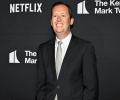
The fact that Gor has President Trump's ear makes him an extremely valuable commodity for India -- he represents both a challenge and an opportunity, points out Aditi Phadnis.
A Parliamentary Standing Committee on Commerce has urged the Indian government to swiftly conclude the proposed India-US Bilateral Trade Agreement (BTA), while ensuring India's interests are protected, recommending complete exemption for key export products like generic medicines and smartphones from future US tariff increases.

US Secretary of State Marco Rubio says relations between India and the US have not lost momentum and are set to strengthen, with hopes for a trade deal soon.

Former PepsiCo CEO Indra Nooyi asserts that India and the United States are natural partners, crucial in the geopolitical competition with China. She highlights India's pivotal role as the world's largest democracy with a young, English-speaking population, despite its "chaotic" nature. Nooyi also discusses the need for leaders to understand each other's perspectives to maintain strong bilateral ties.
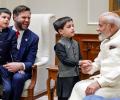
US Vice President JD Vance and Prime Minister Narendra Modi held a phone call to discuss expanding the India-US comprehensive global strategic partnership, focusing on trade, defence, energy security, emerging technologies, and critical minerals. The discussion comes amidst rising tensions in West Asia and recent regional realignments, with both leaders reaffirming their commitment to strengthening cooperation.

New Delhi must look for formal, institutional statements issued directly from Washington rather than rely on casual pronouncements meant for local audiences, notes Ambassador Rajasekhar.
India is waiting for assurance from the US on comparative advantage over other economies under the deal.

The US Commission on International Religious Freedom (USCIRF) has recommended sanctions against the Rashtriya Swayamsevak Sangh (RSS) and advised the US government against extending diplomatic courtesies to its leaders. This comes ahead of RSS Chief Mohan Bhagwat's visit to the US, with USCIRF officials citing allegations of attacks on religious minorities by RSS sub-groups. India has consistently rejected USCIRF's reports as biased and selective.

The US senate last week passed a bill that would allow Washington to impose tariffs on major buyers of Russian energy.

We are back to the 1971 moment with both China and the US supporting Pakistan, asserts Colonel Anil A Athale (retd).

US Vice-President J D Vance's unexpected phone call to Prime Minister Narendra Modi on August 8 has ignited speculation about a potential diplomatic overture, possibly seeking India's support amidst the escalating US-Iran conflict and a shifting global power landscape, suggests Ambassador M K Bhadrakumar.

The question nobody seems to ask is why a democracy should be silent when many of its citizens are concerned about the way the US is deviating from its traditional ways of consultation, cooperation and collaboration and moving away from traditional allies, asks Ambassador T P Sreenivasan.

'Tariff action relating to the excess-capacity investigation will be even more susceptible to judicial overturn.'
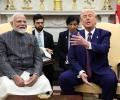
Prime Minister Narendra Modi and US President Donald Trump discussed the West Asia crisis and the importance of keeping the Strait of Hormuz open and secure. They also reviewed progress in bilateral ties and anticipated upcoming deals in the energy sector.

Indian farmers staged a significant protest at the Shambhu border against a proposed India-US trade deal, fearing its detrimental effects on the domestic agricultural sector and demanding its immediate abandonment. They later ended their agitation after assurances from the Haryana Agriculture Minister regarding the release of detained farmers and a meeting with the Union Agriculture Minister.

'The flip side of this is that he won't hesitate to call out India if he thinks its policies are hurting US economic interests or border US foreign policy goals.'

Prime Minister Narendra Modi and US President Donald Trump are set to hold comprehensive talks focusing on a bilateral trade deal, defence cooperation, and energy and critical minerals sectors during the G7 summit in Evian-les-Bains, France.

Prime Minister Narendra Modi urged US President Donald Trump to prioritise the safety of Indian seafarers in the Strait of Hormuz during the implementation of Washington's proposed Iran peace deal, as both leaders focused on repairing strained bilateral relations at the G7 summit.

A readout by the US said the agreement marked a milestone in the strategic partnership between the two nations to ensure that the foundational elements required for advanced technology and energy are available within trusted networks.

US Secretary of State Marco Rubio arrived in Kolkata for a four-day diplomatic tour to India, marking the first visit by a US secretary of state to the city in 14 years. His itinerary includes meetings with Indian officials, energy talks, and a Quad Foreign Ministers Meeting.

Trump lauded the defence relations between India and US and affirmed support precisely for the PM Modi-led nation during conflict situations.

Prime Minister Narendra Modi and US Secretary of State Marco Rubio discussed various aspects of India-US bilateral ties, focusing on defence, trade, energy, and technology. Rubio extended an invitation from President Donald Trump for PM Modi to visit the US.

Gwadar is viewed as a critical pearl in China's maritime strategy as it would give a permanent logistical footprint near an important choke point - the Strait of Hormuz and the oil rich Persian Gulf, explains Commodore Venugopal Menon (retd).

US President Donald Trump lauded Prime Minister Narendra Modi as a "very tough negotiator" and hinted at a future visit to India during their meeting on the sidelines of the G7 Summit, where they discussed trade, defence, and the West Asia crisis.

Indian-American lawmakers are encouraging the diaspora to actively participate in US politics and run for public office at all levels. This call comes amidst increasing incidents of anti-India and anti-Hindu hate, with leaders emphasising that political representation is crucial to address community concerns and ensure their voices are heard.

Prime Minister Narendra Modi and US President Donald Trump exchanged pleasantries and held a brief conversation at the G7 summit, their first in-person encounter in 16 months, setting the stage for high-stakes bilateral talks amidst continuing strain in India-US relations.
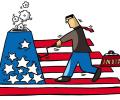
External Affairs Minister S Jaishankar raised India's concerns with US Secretary of State Marco Rubio regarding changes to US visa and immigration policies, emphasising that legal mobility should not be negatively affected. Rubio acknowledged potential 'bumps' during the transition as the US aims to improve its immigration system.

The US embassy spokesperson issued a statement clarifying President Trump's views on India after a controversial social media repost. The statement emphasised the strong relationship between the two countries and Trump's positive view of India's leadership.

US Secretary of State Marco Rubio will visit India for four days to strengthen bilateral relations, holding talks with Indian leaders and attending the Quad foreign ministers' meeting.

India has criticised US President Donald Trump's social media repost referring to India and other countries as 'hellholes' in the context of immigration, deeming the remarks 'uninformed' and 'inappropriate'.

Former US President Donald Trump lauded Prime Minister Narendra Modi as a 'great leader' and 'tough guy' who has been in power for over 12 years, placing him alongside China's President Xi Jinping as leaders he admires for their power and ability to execute.
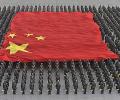
The sudden proximity between India and US has, in the eyes of many, sidelined China. This is not the case, argues Colonel Anil A Athale (retd).

The Indian government informed Parliament that India and the US are engaged in negotiations for a mutually beneficial multi-sectoral bilateral trade agreement. The two countries also cooperate on strategic, economic, and defense matters, managing divergences through high-level dialogues.

India would confront a more entrenched China, a less dependable United States, and a regional order increasingly shaped by great-power bargaining over which it exercises limited influence, notes Amberish K Diwanji.

New Delhi will substantially reduce tariffs on industrial and agricultural goods while continuing to protect sensitive sectors. Tariffs on some agricultural products that are not traditionally considered sensitive will be brought down to zero, while in the case of relatively sensitive items, duties will be reduced in a graded manner and quotas will be imposed.

Taking to Truth Social on Monday evening, Trump reposted Gor's original Sunday night dispatch alongside a video snippet from the grand celebrations marking the 250th anniversary of America's independence, hosted at the iconic Bharat Mandapam in the national capital.

India and the US have decided to reschedule their meeting to finalize the interim trade pact due to recent developments and implications, including changes in US tariffs.

President Donald Trump is a big fan of India and Prime Minister Narendra Modi, US Secretary of State Marco Rubio said on Monday, seeking to dismiss allegations of rising anti-India rhetoric in the US.

Lavrov, who addressed the UN General Assembly shortly before External Affairs Minister S Jaishankar's speech at the high-level General Debate, said India and Russia share a "particularly privileged strategic partnership".

'China continues to perceive its relations with India through the prism of India-US relations, with the US using India to counter balance against China in the Indo-Pacific and beyond.'
